
After 12 hours of flying over a dark ocean, past the dateline and the equator we dove through the scattered white clouds over a lush green, hilly island, ringed by white beaches and with scattered small building amongst the dense foliage. There were no tall buildings, no downtown clusters, just scattered resorts, recognizable because of their pools, along the leeward coast. As soon as we left the plane at Nandi Airport on the main island of Viti Levu, the humidity and heat engulfed us like a sauna. We were still dressed in Vancouver garb: slacks, socks, sneakers, sweaters and we immediately headed for the air-conditioned terminal building.
Customs and check-in were pretty standard and we moved through quickly, collected our luggage and met our pre-ordered driver who deposited us at our Airbnb, listed as a ‘Quaint Rooftop Apartment.’ It was quaint, meaning small and was on the top floor (roof-top) of a two-storey house with a view of the tin-roof of the lower storey, in a residential neighbourhood, not too far from the airport. It is clean and fully equipped including a large TV with Netflix. There is a rickety back-porch right under an enormous mango tree full of noisy myna birds. Nowhere near the water but 5 minutes walking distance from a mall. Our host Filo is a super nice woman who took care of us and even served us up a traditional Fiji breakfast: homemade doughnuts with strawberry jam and lemon-grass tea.
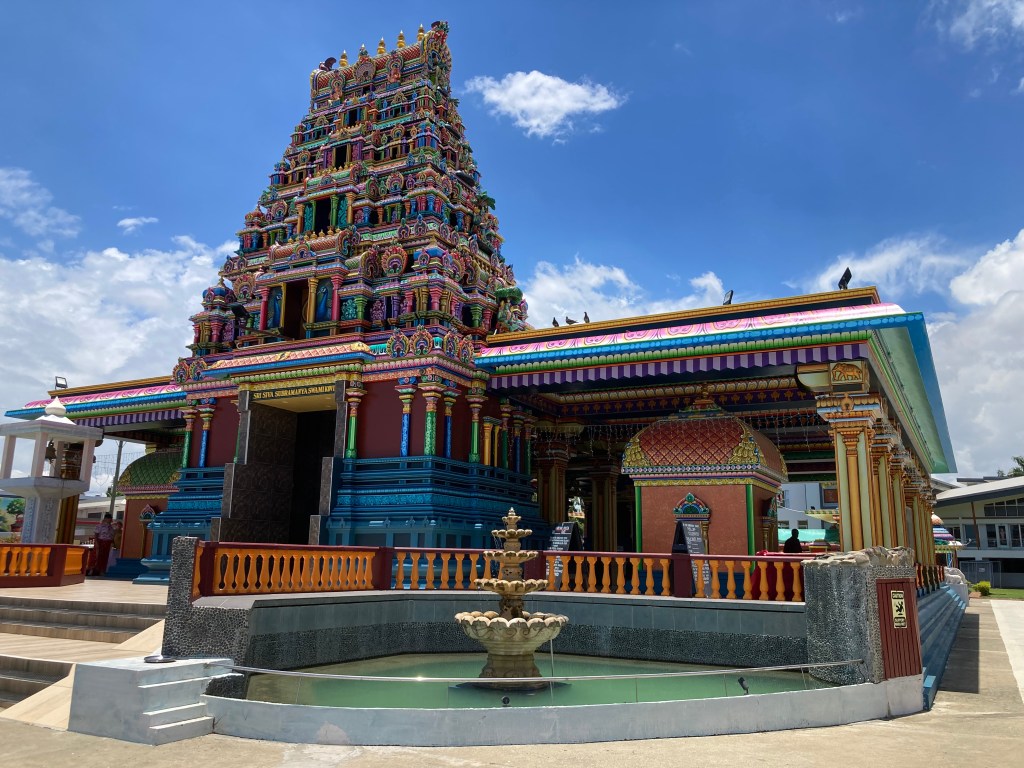
We took a taxi to downtown Nadi and the multi-coloured Hindu Temple adorned from floor to ceiling with with vibrant and gaudy illustrations of the Hindu mythology. It’s a tourist attraction set in a mostly Hindu neighbourhood. Just a few Hare Krishna restaurants, which meant no alcohol. We were dying for a cold beer because the oppressive heat was whacking us on our first day in the tropics. Also, the main-street leading away from the temple was kind of run down with cracked sidewalks and non-functioning traffic lights. There was a depressive, souvenir market – Jacks – void of tourists or customers. Just a collection of makeshift booths or stands, all offering the same carved masks, beaded necklaces and lungis by half-hearted pleas to: ‘please step in, all hand mad, special price just for you.’
We eventually grabbed a cab and made it back to our quaint lodging. For dinner we went to one of several Indian Fusion restaurants tucked into the nearby mall. Very good food and friendly service for a third of what we would pay at home. We also did a spot of shopping at the super-market that sold everything from hardware to toiletries. Not much in the way of fresh food or fruit and the only baked goods were a mountain of white bread – like Wonderbread – in plastic bags, stacked on a table. No whole wheat, no sour dough, no pumpernickel.
We engaged our local cabby, Beato, a grandpa with an easy-going nature and an ancient Toyota Corolla, who waved and shouted at everyone walking or driving by and even pointed out two of his sons, each in a large haul-truck, passing us on the opposite side of the road. He seemed to know everybody. The botanical Garden of the sleeping Giant is named after the mountainous likeness of the ridgeline above the tropical, cultivated landscape. The garden is famous for its unrivalled orchid collection started in 1977 by a Canadian: Raymond Burr of Perry Mason and Ironside fame.
Beato patiently waited for us and then dropped us off at the beach just between the Ramada Inn and the Wyndham’s Garden Hotel. We wanted to see the famed beach which is lined with cookie cutter hotels and resorts, fronted by pools and beach bars just like anywhere else in the touristy beach world. We were disappointed by the narrow, hard-packed, mostly deserted beach. Maybe we’re spoiled by the Grand Anse Beach in Grenada or Playa Norte in Isla Mujeres or indeed, Hillsboro and Paradise Beach in Carriacou. We had a beer and a mediocre but expensive pizza at the Ghostship Bar. And then the rain started pelting down, chasing the few bodies under cover, just as the punters started gathering around the lobby’s TV in time for the Melbourne Classic and their dreamy chances of having picked the winning pony.
We said good-bye to our lovely host, Filo, who had looked after us like an auntie. The two-hour drive from Nadi to the Coral Coast led us through a green and lush countryside with scattered tin-roofed, square box houses lining the newly paved Queensroad. Past a few ramshackle towns with a couple of mechanic shops, a gas station and a grocery store and a cheerful kindergarten that pledged love and care for all ages of children. Large roadside banners promising riches and the best in food and luxury goods were interspersed with a few roadside fruit stands. It felt a bit like driving through Mexico’s heartland but much greener, with palm and even pine trees and plenty of large mango trees and the odd papaya plantation. Also, a couple of Hindu temples, redolent of the large east Indian population and very few people anywhere. It looked poor, not shabby or depressing but poor like there was not enough money for anything except for necessities.
Maybe there is some truth that in these latitudes people just can’t work as hard because the heat saps energy like nothing else. I sure as hell can’t imagine doing physical work here unless somebody forced me with a whip. That of course is how it was. It was called indenture, another word for slavery, when thousands of workers were brought here from India by the British landlords, to work in the sugar and cotton plantations which are long gone. The descendants of those ‘slaves’ make up 40 percent of the Fijian population today which is about one million. They can’t own land, only lease it but seem to have adapted well and today own most businesses in this archipelago of over 300 islands.
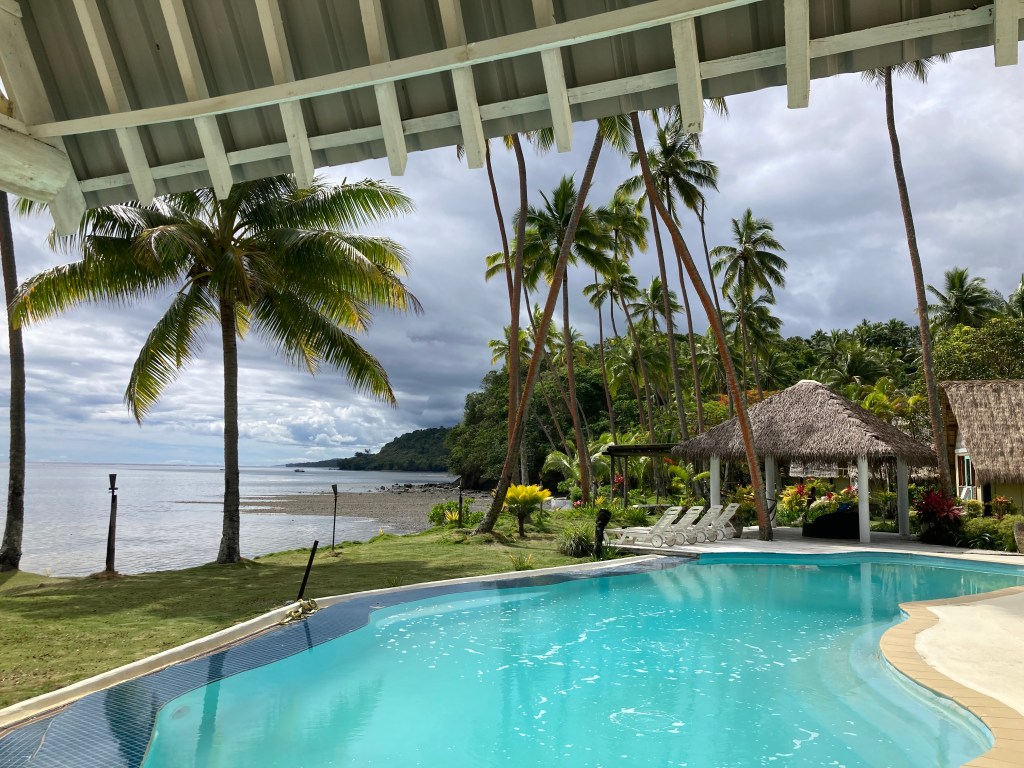
Our driver Billy from the Mango Bay Resort grew up, married, had kids and still lives in a small village just around the corner from the resort. After the two-hour drive, he dropped us off, handed us a key to one of the bures or cabins and left. The bure was underwhelming, without features and character, sparsely furnished with a double-bed, a rusty bathroom sink tap, a desk and a bible. When I turned on the water it came out orange like rust. Oh, yeah, now I remembered. Billy told us not to drink the water. We were next to the jungle right at the back of the resort which was a lovely flat expanse of exotic flowers, coconut palms with a concrete walkway snaking through the ankle deep, soft carpet of grass to the poolside restaurant and the shallow South Pacific shore.
We were greeted by a friendly local server named Moses – call me Mo – and Simon, a potbellied Brit in a gold-coloured jersey from his home team: The Wolves, otherwise known as the Wolverhampton Wanderers, presently last in the Premier League. There were also three mongrel dogs, an orange-coloured battle worn and scared bruiser, aptly named Mango; a black and grey mid-sized sheep dog called Pablo, not after Picasso but Escobar, hence the white snout and a fuzzy white mutt strangely named Killarney that reminded me of Tintin’s dog Snowy.
The mid-sized restaurant was under a steep cone shaped, thatched roof with a curved bar, right beside the saltwater pool which is a good size. Large enough to swim laps in. Oh, I forgot to mention that we were the only guests apart from a tattooed German woman who was in Fiji to learn to dive. Also, as we learned, she was in charge of the Sudanese Doctors without Borders team. Don’t judge a book by its cover.
There were ten empty, A-framed, one-room waterfront cabins with queen-sized beds, an enclosed outdoor shower and gorgeous views. I wrote the owner, who was presently in New Zealand, asking for an upgrade since we were not happy with our present accommodation. A short while later Simon approached me and in his thick British brogue offered to take care of us as instructed by his buddy who owned the place. For a small fee we were duly moved to a lovely beachfront bure, a stone throw from the pool and the bar and the shore. Now, we were happy.
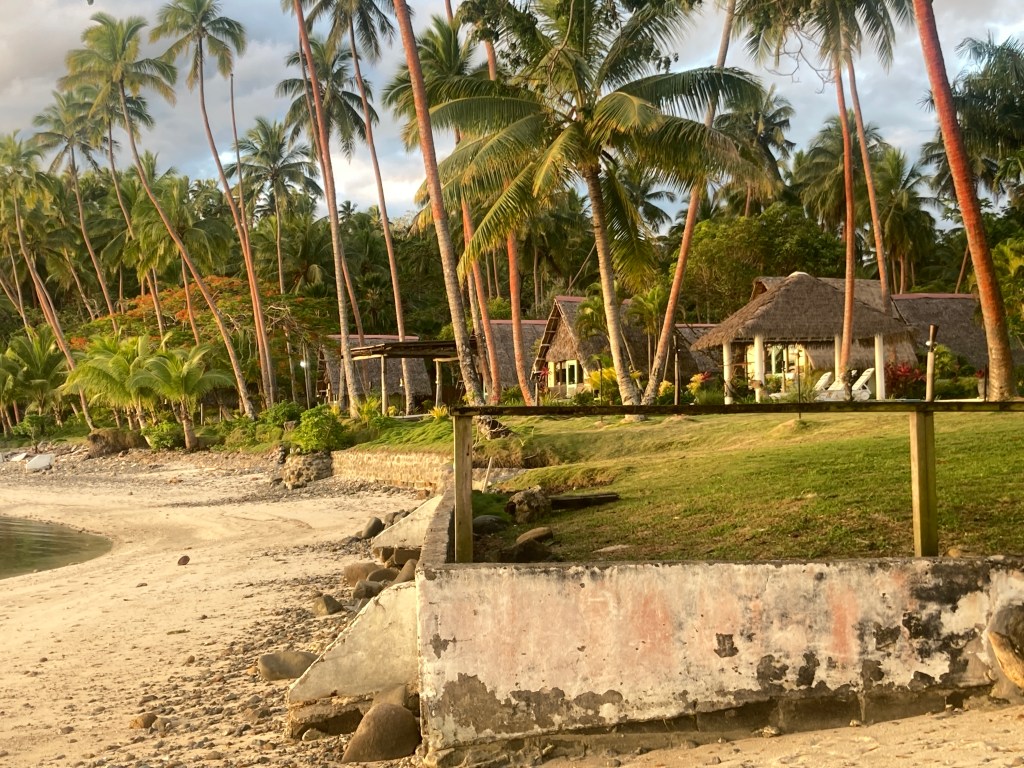
The two-star Mango Bay Resort shows its age but is not shabby or dilapidated, just a bit worn around the edges. This small resort is probably 30 or 40 years old (nobody really knew) and like all older beach front properties anywhere, it sits on a prime piece of real estate: a flat 5 acres right on its own bay. I bet that ten years from now there will be a monolith, part of a big chain resort chain sitting right here in this garden of paradise.
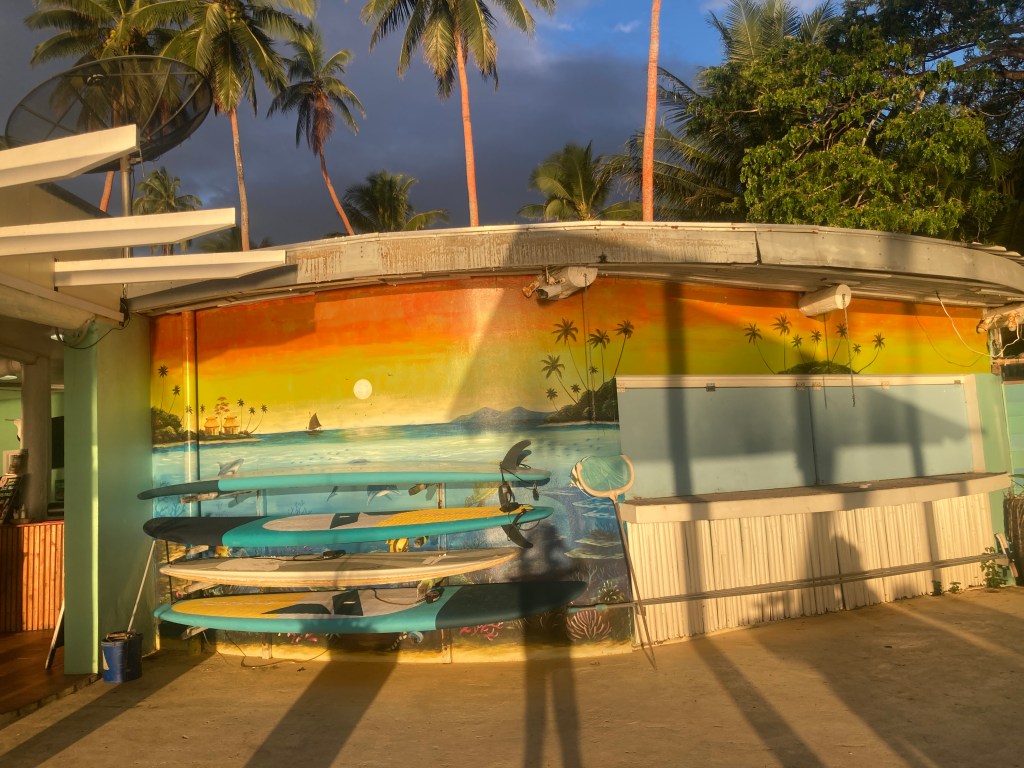
The staff was super friendly and the food was excellent and varied and so were the cocktails. The beach is shallow and tidal and not really meant for swimming. Several paddle boards and kayaks were freely available. There is a ringed reef about a hundred meters out which breaks the incoming surf, making the waterfront very tame. There are hammocks and beach loungers and sunset views to die for and the weather is tropical. Perfect.
 Bruno's point of view