
There is a lot to like about New Zealand. The summery weather from November until April for one, the undulating, green landscape and lush flora, the unique bird population and the 3000km moat around the country. New Zealand has approximately 5 million inhabitants with a population as varied as it’s landscape. About 67% are of European descent while 18% are Maori which is about the same percentage as those of Asian heritage. Other pacific peoples make up about 9%. Most of the names of towns and regions are in Maori language which I have trouble remembering. So many vowels and few consonants do not compute in my European brain.
Canadians are known for their politeness, always excusing themselves, even if they’ve done nothing wrong like two people arriving at the door at the same time both pardoning themselves and insisting the other go first. A Canadian standoff. Where Canadians are polite, Kiwis are just nice, always pleasant, cheerful and helpful, always in good humour and never in a hurry or annoyed. I have yet to meet a grumpy Kiwi. I’m usually the cranky one. I should learn from the locals.

Auckland is a city much like Vancouver with an active waterfront replete with restaurants, hotels, boat harbours and a container port. Passenger ferries are coming and going to places like Devonport, Waiheke Island, both tourist and holiday destinations and Rangitoto, the volcanic island in the Hauraki Gulf. Waiheke is home to several high-end wineries along with multi-million-dollar homes with views of the water and the city scape defined by the Needle, the iconic 328-meter tall Ski Tower in the city center. Devonport is more like a tiny suburb with a busy main street full of tourist shops and restaurants. It is also accessible by road. Both are well worth a day trip and we were envious of the fancy ferry terminals which are basically mini-malls with restaurants, bars and shops. Unlike our utilitarian waiting rooms with a couple of junk-food and pop dispensers.
After about a 20min hike from Eden village, a popular restaurant and art shop neighbourhood, we made it to the top of Mount Eden, Maungawhau in Maori; the largest of the seven volcanic cones that are scattered around Auckland. It features a deep crater and a panoramic view of the city. We also walked up One Tree Hill, recorded by U2 and later in a TV series. The iconic tree, a Monterey Pine, was cut down in 2000 after being damaged by repeated chainsaw attacks by a Maori activist. Just below One Tree Hill is the Star Dome Observatory which offers a great show of the southern night-sky, weather permitting, and we are now able to find the southern cross and never get lost again.
RV’s were quite expensive, so instead we rented a car and opted to stay in hotels or Airbnb’s with kitchens or some elementary cooking facilities. We always had breakfast in – cereal, yogurt, fruit and coffee, sometimes of the instant freeze dried kind. We had lunch in a lot of the time: local avocados, tomatoes, eggs, toast and cheese but for dinner we usually went out.
Did we have a budget? Not really. Prices in NZ are about dollar for dollar but a NZ$ equals 80cents Canadian, so a fifth cheaper. Except petrol which is between NZ$ 2.50 – 2.80 per litre, so a buck more than in Vancouver. On the plus-side there are no taxes or tips added to your purchases, including restaurants. If your meal is $ 50, then you pay just that. No more. Tips are not expected anywhere. What a relief from home where the card readers ask you for anywhere from 18% to 25% tips, even if nobody serves you. Drives me crazy.
The country is made up of two large islands stretching from south to north, separated by the 30 km Cook Straight. The more north you go the warmer the climate and the more exotic the flora. This is our third time to the Land of the long White Cloud and we decided to stick to Northland, north of Auckland and the Coromandel peninsula which is east of Auckland, across the Hauraki Gulf. A very hilly landscape with snaking roads, one-way bridges and steep cliffs. Cinnamon-coloured, sandy beaches are plentiful along the pacific coast like the expansive Ocean Beach in Tairua. The 2hour proximity to Auckland makes the Coromandel a favoured holiday destination. From the 30’000 permanent residents it swells to a quarter million during the Christmas holiday season, most of them Kiwis. It’s like a hundred cruise-ships land all at once. It’s a lifesaving bonanza for restaurants, tourist enterprises and shops of every kind and nobody seems to resent the visitors and holidaymakers after the deadly dull winter. We’re lucky to be here in November, just before the onslaught.

The roads are very windy but in excellent shape. Betty almost got seasick a couple of times. Lots of roundabouts and well-marked for curves and speed. They don’t have frost heaves or worry about black ice or snow. But it’s definitely not safe for bicycle riders. Most secondary roads have no curbs or passing lanes. It would be suicidal on a bike. We almost had a head on collision when an oncoming car passing a couple of bike riders on a blind curve. Inches away. An Idiot.
Hotwater Beach, about half an hour drive north of Tairua, is unique because at low tide the warm water seeps up through the sand and people dig little puddles and sit in them until the next wave wipes it all out again. We rented a shovel for $ 10 and dug up some beach. I felt a bit silly sitting in the warm puddle with a shovel like a kid. We didn’t last long and instead went for lunch at Hotties, the local beach café.
A few minutes further on is a popular half-hour hike down to the Cathedral Cove Caves. The reward is two beaches on either side of the dramatic cathedral-like walk-through cave at the bottom of steep ochre-coloured cliffs. Cameras were clicking non-stop.
There is also a small Kauri reserve walk close by on highway 25 with a few left-over big trees. 99% or thousands of acres of these legendary trees have been harvested for spars and masts, lumber and furniture. They are a straight, pine like softwood conifer and can get to be over 2000 years old. There are only a handful of these giants left, all of them tourist attractions, glorifying a past that we can’t even imagine. There are a lot of hikes along marked and groomed tracks (not trails) in Northland and all over New Zealand and we did quite a few of them.
Cooks Beach is also not far from Tairua – where we’re staying – and it has a very scenic winery with a restaurant named after Mercury, the planet, which was observed here by Captain Cook in 1769. That guy seems to have left his imprint everywhere. He sure got around. An Italian woman from Napoli is in charge of the woodfired pizzas at Mercury and they were the best, anywhere. I’m a bit of a pizza snob since I make my own and always look for ways to improve. She shared a couple of valuable tips.
After a week in Tairua we drove to Coromandel Town, which is a on the Hauraki Gulf at the northern top of the peninsula and consists of a main street with tourist shops, boutiques, pubs and eateries. Pleasant and quaint and famous for its green-lipped mussels and oysters. There is one lone 1200year old Kauri tree in Long Bay which we had to go and see. The harbour is shallow and turns into a vast mudflat twice a day.
Then a three-hour drive around the gulf right back through Auckland brought us up to Snells Beach which sounded like a beach town but turned out to be a bedroom community of Auckland. We stayed at the cavernous Salty Dog Inn, a faux English pub complex, built in the 80ies, with adjacent lodging. There were no restaurants except the empty pub but we did find the Brick Bay Winery close by. They served excellent Greek style food inside a glass house beside a pond and lunch included a walk through a sculpture park which showed off some bizarre and some genius sculptures like the ghost Kauri trees made out of stamped aluminum cylinders hung amongst the real trees and surrounded by an esoteric classic music ambiance.
A half hour drive from The Salty Dog Inn is Matakana which features a famous Saturday market. We dined at the Market Kitchen Restaurant beside a lazy creek populated with eels and flanked by an exotic garden with fern, palm and cabbage trees. An effusive Brazilian mêtre-dis took our order of a mixed grill platter but the steak was totally overcooked. He promised to fix it but then conveniently told us he forgot to inform the chef. For compensation he offered us a free crème-brulé, made by his wife, he insisted. A clever ploy because he didn’t want to piss off his chef by complaining and he didn’t want to get a bad review from the one-time tourists either. Having owned a restaurant, I could easily see through his charade but he was an enthusiastic and personable guy and the dessert was delicious.
Going north we passed through Kawakawa, famous for its Hundertwasser public toilet with its colourful pillars, like something out of 1001 nights. The eccentric Austrian artist lived in the Kaurinui Valley on a 200-hectare farm he purchased in 1975. He lived there for the last 25 years of his life, making it his primary New Zealand home.
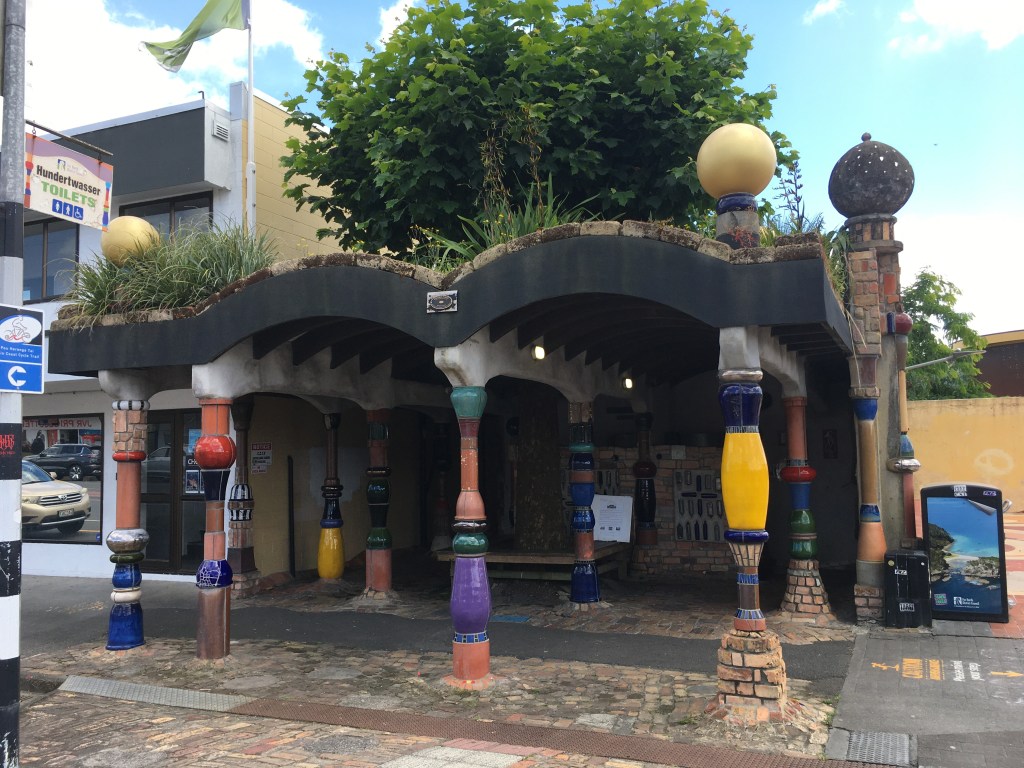
Regarding public toilets: They are everywhere you need them and they are clean and maintained. Unlike in Canada where you have to go into a restaurant and sneak to the bathroom or consume an unwanted beverage.
We picked Russell in the Bay of Islands as a destination stop. It is a small pleasant beach town with some classic, whitewashed, Edwardian mansions with white picket fences. Some are turned into hotels and restaurants like the very British Duke of Marlborough with its chintz upholstered chairs and large leather club furniture which hark back to an older age when Russell consisted of dozens of brothels and grog shops. Only one grog shop (liquor store) remains and no more brothels. Instead, there are boutiques, cafés, ice-cream parlours, restaurants and souvenir shops lining the pleasant, gentle swimming beach. Hourly ferries carry passengers back and forth to Paihia across the bay. Pohutakawa trees, already in full red Christmas bloom, line the shoreline amidst palm and cabbage trees. Several varied boat excursions to many of the 144 islands are available and there are plenty of hikes and well marked tracks. Russell is a holiday destination! We took a one-hour bus tour and the driver was a local Maori comedian and entertained us with history, jokes and spectacular vistas. Well worth the NZ 30.
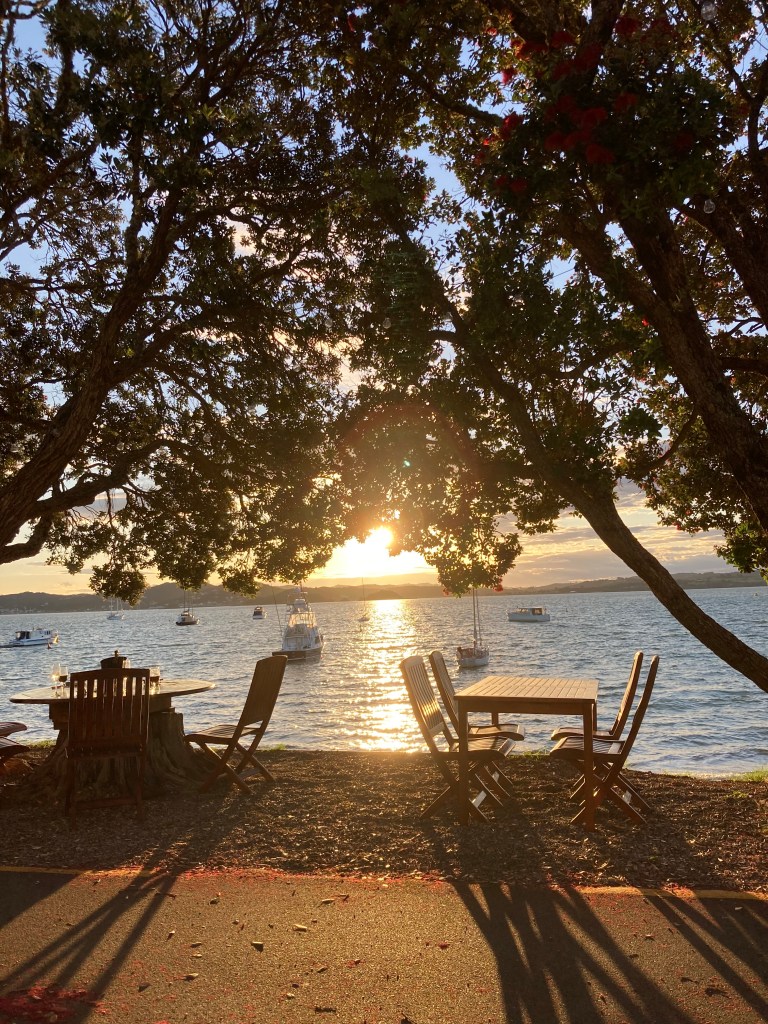
Our next stop was Coopers Beach, just past Mangonui in Doubtless Bay, named thus because apparently of what Captain Cook said when he sailed past: ‘Doubtless a bay.’ The wide, golden sandy beach is lined with large Pohutokawa trees and a magnificent sight to behold around this time of year. It’s mostly a residential town with lots of holiday ‘baches’ (originally named for bachelor cabins for returning service men after the war. Today they are fancy holiday homes). There are only a couple of small cafés and some take-out food trucks in Coopers Beach. We stayed in an Airbnb cabin, just a short walk above the beach. Brand-new and modern with everything we needed and a nice little back patio with a banana tree. A scenic half hour beach and bush-walk on a well-marked trail brought us to Mangonui which has a few restaurants and a famous fish-and-chips restaurant right on the water. We opted instead for the Wine and Whiskey Bar.
We booked a day long bus-tour up to Cape Reinga, the northernmost tip of New Zealand. I’m usually no fan of organized tours but this one turned out to be fun, not just a senior’s tour but with mixed age passengers. Our driver was an entertaining story teller and was full of pertinent information about the people, the history and the geography. He was a local Maori and knew many people along the way. They were all his relatives. To him Cape Reinga was more than a tourist attraction. It was a spiritual place and he intoned a long welcoming prayer in his own language as we entered the mist covered cape. As we descended on foot towards the lighthouse, the mist lifted and we had an unobstructed view of the divide between the Pacific and The Tasman oceans as well as a very scenic photo-op of the lighthouse and the pristine beach below. On the way back we drove along 90 mile beach and did some sandboarding on boogie boards down a couple of sand dunes. Good fun, except I was covered in fine sand, even in places I didn’t think possible.

After five days in Cooper’s Beach, where we did a lot of hiking and walked the 2km long beach from end to end a couple of times, we were ready to move on. We decided to drive down the west coast along the Tasman Sea and through what they call the Kauri trail. There is the mandatory walk to see the giant Tāne Mahuta tree, north of Dargaville, which is estimated to be over 2000 years old and is as wide as a house. The narrow road, barely wide enough for two passing cars, with no shoulders, snakes along for a couple of hours towards Dargaville. I felt like a rally driver and Betty was seasick and her nerves were shattered.
We had booked a motel which turned out ok. We had a room with a small kitchenette right next to the pool which was a welcome bonus. Dargaville has seen better days, that much was clear. Wide, mostly empty streets and boulevards; a downtown with several second-hand shops and dollar stores; the century old buildings in need of a paint job or a fix-up, a few restaurants and take-out places. Once a main center of logging and fishing and kauri gum (the amber-like tree sap buried with the whole forest of gigantic trees, thousands of years ago in the former swamps, as a result of volcanic activity); it is today a sad reminder of former prosperity. We did however learn about the Dally’s, Dalmatian or Croatian immigrants who flocked to these parts by the thousands, lured by the gold-rush like fever for Kauri-gum which was used for glues, varnish, paints and linoleum. With the invention of synthetic products, the need for the kauri gum which had to be dug up with spades, mostly by hand, vanished overnight. The Dalmatian migrants and their descendants turned their ambition and skills towards farming and wine making, evident to this day.
We also got to witness the Christmas parade which featured a Scottish pipe band which nobody could hear because they were closely followed by emergency vehicles with their sirens blaring at full blast. A few makeshift floats, decked out in Christmas decorations filled with kids from the dance school and the rugby club followed by the Dalmatian string band, the ‘boot scooters’ line-dancers and the real-estate sport coupe with a couple of pretty local girls. A random collection of antique tractors and machinery rounded out the hokey parade. It brought out the town’s people who obviously enjoyed the spectacle. For us it felt slightly weird because the summery sun was beating down and everybody was in t-shirts and sun hats, even Santa Claus.
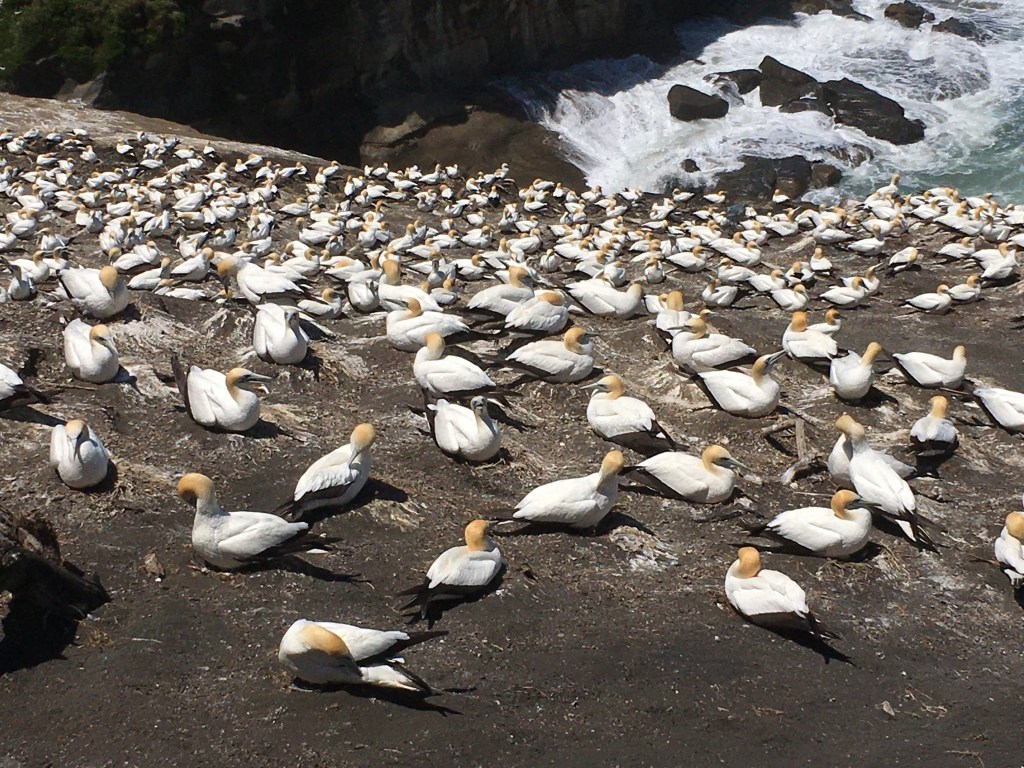
From Dargaville we made a detour to the Gannet colony in Muriwai Beach where thousands of these singular birds roost and nest on the exposed cliffs. You can walk right up to them and they completely ignore the gawking tourists. They are a mix between a seagull and an albatross and can spend years away in Oz (Australia) before returning here to nest. They mate for life and it amazed me how these birds find each other’s mate amongst the thousands sitting on their nests right next to each other. To me they all looked the same. A fascinating display of nature at its best.
The next stop was Piha Beach, a popular surf beach, less than an hour from Auckland, at the bottom of a steep cliff, accessible only by a narrow road, precariously snaking down to the beach. The surf here is ideal and safe with a large campground right next to it. We rented a Tiny House, built on to the steep cliffside, a few hundred feet above the beach. We had a spectacular view of the blue Tasman Sea and could just glimpse and hear the frothing surf below. Since there were no restaurants, only a couple of food trucks we went to the local RSA (Royal New Zealand Returned and Services’ Association) which is the equivalent of a Legion in Canada. It had a great menu, cheap beer and a garden view. We had to sign in and I had to remove my hat.
It took us 3 hours to drive from Piha back to Tairua for our last week. We decided to stay in one place and do a few day trips, rather than keep driving from town to town and beach to beach which is exciting but tiring. We were lucky to be able to rent the same entire house with a panoramic view and all the amenities of modern life, including a wrap-around deck. The house also had a washing machine, an expresso coffee maker and a fully equipped kitchen. A home away from home.
We reclined on lounge chairs with sunglasses in the summery, sunny mornings, listening to the jabbering and bell-like notes, clicks, and wheezes of the Tui bird. This is an endemic native of New Zealand; a nectar sucking honey eater with a white, fluffy ascot and iridescent blue, purple and green mixed with its black plumage. Apparently, it is one of the few birds that can imitate human speech – and even accents. I tried talking Swiss German to it but got no response. Probably too strange even for a Tui.
After six weeks we were sad to go home. The weather was just turning into summer, two weeks before Christmas and we can see the floods and atmospheric rivers awaiting us at home.
New Zealand is more than a travel destination; it is a comfort zone without the challenges of a different culture and language, without the discrepancy of the many poor against the few rich and without the generic resorts dotting the beaches like they are from the Baja all the way to the Caribbean. These self-indulgent pleasure islands are often in stark contrast to the native population who are reduced to underpaid servants and desperate merchants of souvenirs and local crafts. None of that in New Zealand. There are many attractions and opportunities for visitors without being made to feel like a different class of people. It always feels comfortable and we didn’t miss a thing. We love New Zealand. We’ll be back.

 Bruno's point of view