Sant Martin/Sint Maarten – West Indies


Saint Martin/Sint Maarten is about 90sqkm and has around 70’000 residents; 44’000 on the Dutch and approx. 26’000 on the French side. Double that over the winter tourist season. Compare that to Grenada which is about 350sqkm with about 110’000 permanent inhabitants. Saint Martin is not considered a 3rd world country despite the appearance of some neglected neighbourhoods. 

The majority of residents are expats from other Caribbean islands. Both sides of the island have proper minimum wage legislation, social services, mandatory insurance and labor protections laws. Because Sint Maarten has no customs duty importing any kind of goods can be done within a reasonable cost. The stores are well stocked with all kinds of consumer goods and luxury items. In fact, Sint Maarten is a shopping destination for consumers from many other Caribbean islands and not only popular with the cruise ship crowd. 

The island features two main cities, Marigot on the French side and Philipsburg on the Dutch side, along with several smaller towns like Grande Case on the north-east leeward side. The town is a jumble of crumbling, dilapidated Créole houses next to new, modern shops; dirty, narrow alleys and crumbling sidewalks along water front boutiques and restaurants, catering to the tourists and locals alike.

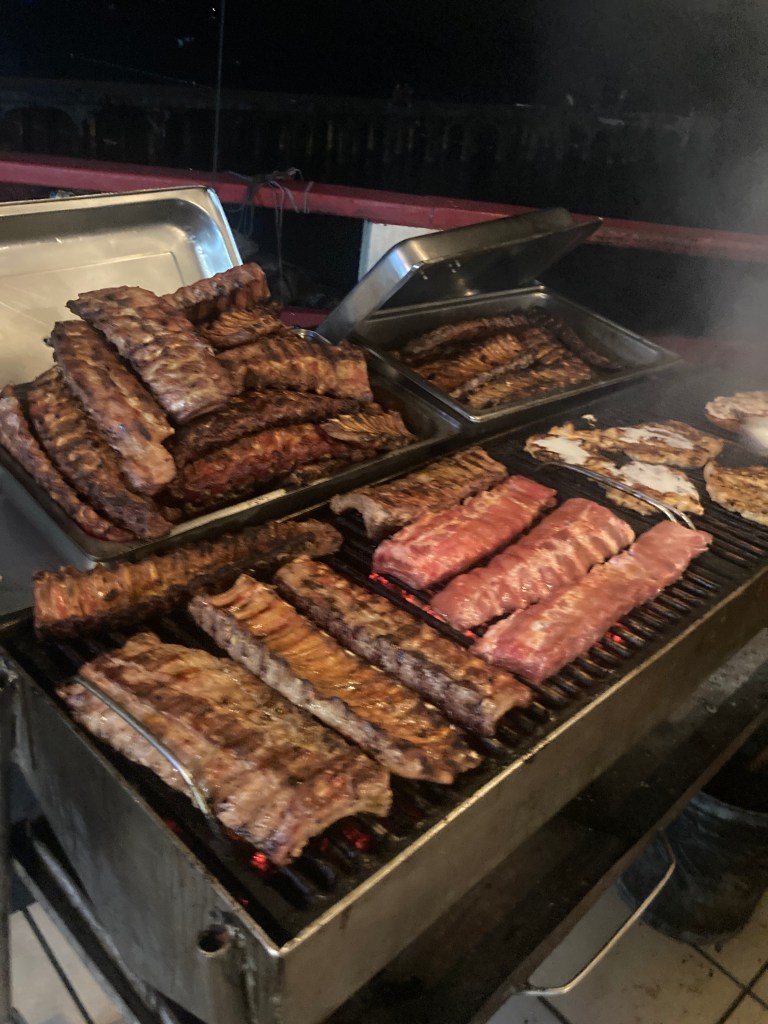
Our friend Pierre introduced us to Lolo’s, a sprawling, busy Creole eatery with picnic tables seating a couple of hundred people right on the water front in Grand Case. The large bbq’s in a haze of greasy smoke were laden with ribs, chicken and fish. A loud, fun place and the prices were decent. The four of us ate and drank for 85 Euros. Ten percent tip included. 

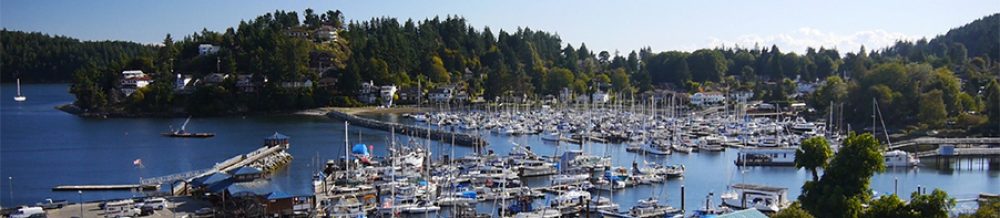
Marigot, the French capital, is built around the harbour front where scores of multi-million-dollar yachts are docked. Ferries from here serve other close islands like St. Barts and Anguilla, both of which can be seen on the horizon. There is a small market offering beach wear and souvenirs and a row of cheap eateries catering to locals and tourists alike. We had a good lunch of crêpes at Sandy’s. 

Philipsburg is home to the international airport and cruise ship docks. A wide waterfront boulevard with beach bars and hotels fronts the harbour, also home to a dozen superyachts. There are two parallel shopping streets, one row back from the waterfront – the first one high-end and closed to traffic, the other one not so much. Both streets were lined with side-by-side tourist stores offering the same gaudy T-shirts, beach wear, souvenirs and luggage along with the usual name-brand fashion outlets and at least a dozen jewellery stores. Obviously catering to the cruisers. We were kind of disappointed. The only redeeming feature were some of the older buildings with Creole style ornamented facades. Philipsburg also has some residential high-rises which is the first thing we noticed while flying in to the island. Multi-storied 4 and 5star hotels and casinos, reminiscent of the other Dutch island, Curaçao, extend towards the Simpson Bay Lagoon and the airport. It looks more like Miami Beach than a small Caribbean island. 

The French side has hundreds of villas and condos spread along the beaches and bays and up the rocky inclines which are overgrown with impenetrable, green, thorny scrub. Both jurisdictions feature large supermarkets, box stores and malls and dozens of hotels and resorts. There are no gardens on the island because there is no water. Water is supplied from a desalination plant, not suitable for watering anything except the toilet and washing machine. 

In 2017, Hurricanes Irma and Maria devastated the island. Ninety percent of all infrastructure was affected, much like Carriacou in 2024. The island is still dotted with ruins that bake away, crumbling in the eternal sunshine.

Cars are forced to drive on potholed island roads with no curbs while pedestrians dodge along parked cars without sidewalks and parking is at a premium. Kamakaze motorcyclists weave in and out of traffic at frightening speeds, many with no helmets or protective gear despite countless speed bumps.  

It is a busy, sprawling island and we have to dig whatever French we know from the recesses of our old brains. C’est la vie. Mind you, most everybody speaks some English, especially on the Dutch side.  Restaurants are expensive and the tourists are mainly American. They are easy to spot.

If you’re a foodie, St. Martin is after all French. Think baguettes, croissants, Camembert, duck breast, pâté foie gras and of course French wines. No taxes, no duties. For example, a box of 18 bottles of 1664 beer is € 7.30 or US$ 8.40. The same goes for cigarettes or cigars. 

We were lucky to have a local friend who drove us around and showed us the local spots like Marcel Beach and the Little Beach. Pierre also had access to a couple of kayaks which we used frequently, paddling out to a couple of small islands in the Étang de la Barrière, on the north side.

It’s hot here, every day. There are mosquitos but not overwhelming. One of the main worries is the Sargassum seaweed that floats in large matt-like masses and clogs up the beaches and waterways. While decaying, it releases stinky and toxic hydrogen sulfide gas, causing health issues and forcing people to vacate their fancy beachfront homes during Sargassum blooms. They occur mostly during the summer months but earlier every year.

I would recommend Grenada over Sint Maarten/Saint Martin, simply because of the vibe, the friendly local people and the fact that it has plenty of water and is therefore lush and colourful. Also, St. Georges has a historic waterfront around the carenage that is both picturesque and authentic. 

AI


Camp is away this week and I thought I’d take up the slack and dive into one topic that seems to be impacting our world, from finances to politics, from science to philosophy: Artificial Intelligence or AI.

Since neither I nor Camp know an awful lot about AI, I decided to read up on it. While scanning a myriad of articles on the subject a friend pointed me to this guy. Dario Amodei, co-founder of Anthropic, one of the leading AI developers. 

Here are some excerpts from two long essays he wrote in 2023 and 2025 respectively.  The first one: ‘Machines of loving grace’, is a bit of a love-story in which he expands on the usefulness and limitless potential of Artificial Intelligence and its effects on modern democracy and indeed the survival of it. The second essay deals with the possible risks and downsides. A more sober view. Both are very informative, written by Dario himself or his team of experts. 

https://www.darioamodei.com/essay/machines-of-loving-grace

https://www.darioamodei.com/essay/the-adolescence-of-technology#top

One concern in both developed and developing worlds alike is people opting out of AI-enabled benefits (similar to the anti-vaccine movement, or Luddite movements more generally). There could end up being bad feedback cycles where, for example, the people who are least able to make good decisions opt out of the very technologies that improve their decision-making abilities, leading to an ever-increasing gap and even creating a dystopian underclass. 

AI seems likely to enable much better propaganda and surveillance, both major tools in the autocrat’s toolkit. It’s therefore up to us as individual actors to tilt things in the right direction: if we want AI to favor democracy and individual rights, we are going to have to fight for that outcome. I feel even more strongly about this than I do about international inequality: the triumph of liberal democracy and political stability is not guaranteed, perhaps not even likely, and will require great sacrifice and commitment on all of our parts, as it often has in the past.

Just as feudalism became unworkable with the industrial revolution, the AI age could lead inevitably and logically to the conclusion that democracy (and, hopefully, democracy improved and reinvigorated by AI, as I discuss in Machines of Loving Grace) is the only viable form of government if humanity is to have a good future.

Another kind of disempowerment can occur if there is such a huge concentration of wealth that a small group of people effectively controls government policy with their influence, and ordinary citizens have no influence because they lack economic leverage. Democracy is ultimately backstopped by the idea that the population as a whole is necessary for the operation of the economy. If that economic leverage goes away, then the implicit social contract of democracy may stop working.

Related to this, the coupling of this economic concentration of wealth with the political system already concerns me. AI datacenters already represent a substantial fraction of US economic growth and are thus strongly tying together the financial interests of large tech companies (which are increasingly focused on either AI or AI infrastructure) and the political interests of the government in a way that can produce perverse incentives. We already see this through the reluctance of tech companies to criticize the US government, and the government’s support for extreme anti-regulatory policies on AI.

Taking time to carefully build AI systems so they do not autonomously threaten humanity is in genuine tension with the need for democratic nations to stay ahead of authoritarian nations and not be subjugated by them.