Someone said: I’d love to see the Aurora Borealis, commonly known as the northern lights. These are caused by solar storms or flares and coronal mass ejections which interact with the earth’s magnetic field causing these colourful displays of celestial phantasmagoria. Sounded great. Who wouldn’t want to see this natural light show?
When is the best time to see this? Not in the winter when it’s dark for twenty-three and a half hours. Not in the summer when it never gets dark. Not in the fall when it’s still nice and temperate, even in the Yukon. ‘No, it’s best in the middle of March, just before breakup,’ someone said. Who is breaking up? Nobody. It’s the time when the ice and snow melts and the rivers groan and heave when they break into large chunks of deadly ice, jamming and damming along the banks, under the bridges and also taking away the ice roads which connect the two shores of the Yukon and the Klondike rivers during the winter months. We wanted to be there before that happened. We agreed on the first week of March as the time when all of us would be around (some of us spend the winters in the sun) and before the gardens needed attention. Temps should be wintry but not too cold and the skies would be clear.
Saint Martin/Sint Maarten is about 90sqkm and has around 70’000 residents; 44’000 on the Dutch and approx. 26’000 on the French side. Double that over the winter tourist season. Compare that to Grenada which is about 350sqkm with about 110’000 permanent inhabitants. Saint Martin is not considered a 3rd world country despite the appearance of some neglected neighbourhoods.
The majority of residents are expats from other Caribbean islands. Both sides of the island have proper minimum wage legislation, social services, mandatory insurance and labor protections laws. Because Sint Maarten has no customs duty importing any kind of goods can be done within a reasonable cost. The stores are well stocked with all kinds of consumer goods and luxury items. In fact, Sint Maarten is a shopping destination for consumers from many other Caribbean islands and not only popular with the cruise ship crowd.
The island features two main cities, Marigot on the French side and Philipsburg on the Dutch side, along with several smaller towns like Grande Case on the north-east leeward side. The town is a jumble of crumbling, dilapidated Créole houses next to new, modern shops; dirty, narrow alleys and crumbling sidewalks along water front boutiques and restaurants, catering to the tourists and locals alike.
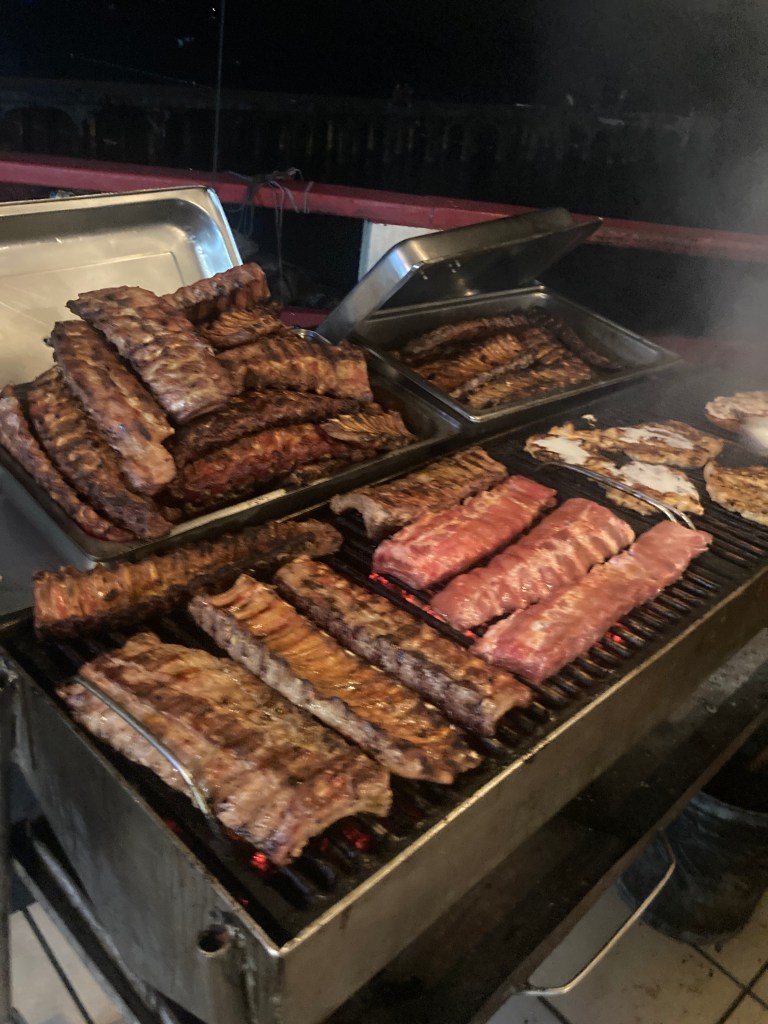
Our friend Pierre introduced us to Lolo’s, a sprawling, busy Creole eatery with picnic tables seating a couple of hundred people right on the water front in Grand Case. The large bbq’s in a haze of greasy smoke were laden with ribs, chicken and fish. A loud, fun place and the prices were decent. The four of us ate and drank for 85 Euros. Ten percent tip included.
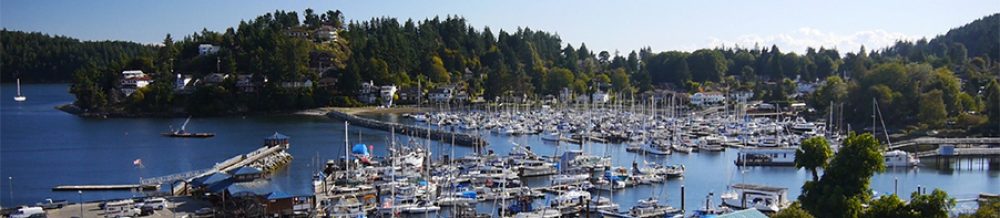
Marigot, the French capital, is built around the harbour front where scores of multi-million-dollar yachts are docked. Ferries from here serve other close islands like St. Barts and Anguilla, both of which can be seen on the horizon. There is a small market offering beach wear and souvenirs and a row of cheap eateries catering to locals and tourists alike. We had a good lunch of crêpes at Sandy’s.
Philipsburg is home to the international airport and cruise ship docks. A wide waterfront boulevard with beach bars and hotels fronts the harbour, also home to a dozen superyachts. There are two parallel shopping streets, one row back from the waterfront – the first one high-end and closed to traffic, the other one not so much. Both streets were lined with side-by-side tourist stores offering the same gaudy T-shirts, beach wear, souvenirs and luggage along with the usual name-brand fashion outlets and at least a dozen jewellery stores. Obviously catering to the cruisers. We were kind of disappointed. The only redeeming feature were some of the older buildings with Creole style ornamented facades. Philipsburg also has some residential high-rises which is the first thing we noticed while flying in to the island. Multi-storied 4 and 5star hotels and casinos, reminiscent of the other Dutch island, Curaçao, extend towards the Simpson Bay Lagoon and the airport. It looks more like Miami Beach than a small Caribbean island.
The French side has hundreds of villas and condos spread along the beaches and bays and up the rocky inclines which are overgrown with impenetrable, green, thorny scrub. Both jurisdictions feature large supermarkets, box stores and malls and dozens of hotels and resorts. There are no gardens on the island because there is no water. Water is supplied from a desalination plant, not suitable for watering anything except the toilet and washing machine.
In 2017, Hurricanes Irma and Maria devastated the island. Ninety percent of all infrastructure was affected, much like Carriacou in 2024. The island is still dotted with ruins that bake away, crumbling in the eternal sunshine.
Cars are forced to drive on potholed island roads with no curbs while pedestrians dodge along parked cars without sidewalks and parking is at a premium. Kamakaze motorcyclists weave in and out of traffic at frightening speeds, many with no helmets or protective gear despite countless speed bumps.
It is a busy, sprawling island and we have to dig whatever French we know from the recesses of our old brains. C’est la vie. Mind you, most everybody speaks some English, especially on the Dutch side. Restaurants are expensive and the tourists are mainly American. They are easy to spot.
If you’re a foodie, St. Martin is after all French. Think baguettes, croissants, Camembert, duck breast, pâté foie gras and of course French wines. No taxes, no duties. For example, a box of 18 bottles of 1664 beer is € 7.30 or US$ 8.40. The same goes for cigarettes or cigars.
We were lucky to have a local friend who drove us around and showed us the local spots like Marcel Beach and the Little Beach. Pierre also had access to a couple of kayaks which we used frequently, paddling out to a couple of small islands in the Étang de la Barrière, on the north side.
It’s hot here, every day. There are mosquitos but not overwhelming. One of the main worries is the Sargassum seaweed that floats in large matt-like masses and clogs up the beaches and waterways. While decaying, it releases stinky and toxic hydrogen sulfide gas, causing health issues and forcing people to vacate their fancy beachfront homes during Sargassum blooms. They occur mostly during the summer months but earlier every year.
I would recommend Grenada over Sint Maarten/Saint Martin, simply because of the vibe, the friendly local people and the fact that it has plenty of water and is therefore lush and colourful. Also, St. Georges has a historic waterfront around the carenage that is both picturesque and authentic.
There is a lot to like about New Zealand. The summery weather from November until April for one, the undulating, green landscape and lush flora, the unique bird population and the 3000km moat around the country. New Zealand has approximately 5 million inhabitants with a population as varied as it’s landscape. About 67% are of European descent while 18% are Maori which is about the same percentage as those of Asian heritage. Other pacific peoples make up about 9%. Most of the names of towns and regions are in Maori language which I have trouble remembering. So many vowels and few consonants do not compute in my European brain.
Canadians are known for their politeness, always excusing themselves, even if they’ve done nothing wrong like two people arriving at the door at the same time both pardoning themselves and insisting the other go first. A Canadian standoff. Where Canadians are polite, Kiwis are just nice, always pleasant, cheerful and helpful, always in good humour and never in a hurry or annoyed. I have yet to meet a grumpy Kiwi. I’m usually the cranky one. I should learn from the locals.
Auckland is a city much like Vancouver with an active waterfront replete with restaurants, hotels, boat harbours and a container port. Passenger ferries are coming and going to places like Devonport, Waiheke Island, both tourist and holiday destinations and Rangitoto, the volcanic island in the Hauraki Gulf. Waiheke is home to several high-end wineries along with multi-million-dollar homes with views of the water and the city scape defined by the Needle, the iconic 328-meter tall Ski Tower in the city center. Devonport is more like a tiny suburb with a busy main street full of tourist shops and restaurants. It is also accessible by road. Both are well worth a day trip and we were envious of the fancy ferry terminals which are basically mini-malls with restaurants, bars and shops. Unlike our utilitarian waiting rooms with a couple of junk-food and pop dispensers.
After 12 hours of flying over a dark ocean, past the dateline and the equator we dove through the scattered white clouds over a lush green, hilly island, ringed by white beaches and with scattered small building amongst the dense foliage. There were no tall buildings, no downtown clusters, just scattered resorts, recognizable because of their pools, along the leeward coast. As soon as we left the plane at Nandi Airport on the main island of Viti Levu, the humidity and heat engulfed us like a sauna. We were still dressed in Vancouver garb: slacks, socks, sneakers, sweaters and we immediately headed for the air-conditioned terminal building.
Customs and check-in were pretty standard and we moved through quickly, collected our luggage and met our pre-ordered driver who deposited us at our Airbnb, listed as a ‘Quaint Rooftop Apartment.’ It was quaint, meaning small and was on the top floor (roof-top) of a two-storey house with a view of the tin-roof of the lower storey, in a residential neighbourhood, not too far from the airport. It is clean and fully equipped including a large TV with Netflix. There is a rickety back-porch right under an enormous mango tree full of noisy myna birds. Nowhere near the water but 5 minutes walking distance from a mall. Our host Filo is a super nice woman who took care of us and even served us up a traditional Fiji breakfast: homemade doughnuts with strawberry jam and lemon-grass tea.
From the ferry approaching Tyrell Bay the island looked much the same as I remembered it. Colorful houses and roofs spread across the green hillside and plenty of sail boats anchored in the harbour. On closer inspections there seemed to be quite a few blue roofs which turned out to be tarps and sailboats without masts. It was to be expected after the devastating impact Hurricane Beryl had on the small island.
The Chinese built ferry terminal building had no roof anymore and was closed. We all disembarked and walked through an opening in the fence across the large parking lot toward the road. Driving along towards Hillsborough the true extent of the carnage Beryl left behind in July was evident everywhere and made us stare in silence and shock. ‘It’s much better than it used to be,’ our driver said, displaying the sunny optimism of many of the locals despite hardship and heartbreak. ‘There is much progress.’ It was hard for us to see. So many destroyed homes and missing buildings with only the tiled floors left behind as silent witnesses. Sometimes with a cubicle like a telephone booth left standing; remnants of a former bathroom.
I was outnumbered and thereby bamboozled by a super-majority including my wife, sister and two cousins that an 8-day cruise down the Rhein from Basel to Rotterdam and back was just the thing to do. Easy, luxurious, entertaining and expensive. Not one to rock the boat – no pun intended – I agreed and paid in full, up front.
We were picked up by a tour bus handled by our jovial and expert driver George at the Zürich Airport and promptly delivered dockside in Basel. As I suspected, the average age of the cruisers was somewhere between the last supper and the grave. I reluctantly followed the slow procession down the gang plank, just in time for our first cocktail served in the forward lounge.
We all took possession of our cabins, ours being just below water level while everybody else had opted for the French balconies on the deck above the water. Being chastised for being cheap I inquired about an upgrade which was going to be 300 euros, per person. ‘That’s a lot of beers and cocktails,’ I protested and ‘since we’re only in the cabins to sleep, I’m happy to be in steerage.’ I won that argument.
We had a plan for the first day. We were going to make it to Port Townsend on the Olympia peninsula, just a day’s drive from home. Since it was the end of October, naturally it was a grey and rainy day. Our first stop was the Peace Arch border crossing. Was my pot bust from 1974 in Montreal going to affect my status? Were they going to confiscate our camper van, throw us out? We had our spiel rehearsed: No arguing and contradicting each other like the last time we crossed into the USA. As in:
Border guard: How long to you plan to stay in the USA?
Me: About a month
Betty: Maybe more like two months
Boarder guard: And where do you plan to travel to?
Me: San Diego, I have a cousin there.
Betty: We’re also planning to go to Mexico
Border guard: Maybe you two should talk. Have a nice trip.
We waited about an hour in line until we finally got to the checkpoint. The young border guard just wanted to know how long we planned to stay. I answered. Betty smiled. He wished us a good trip. We were in. Just like that. Travelling USA.
A couple of hours later we arrived at the Coupeville ferry terminal on Whitbey Island. The 20minute sailing deposited us in Port Townshend. The ferry itself was an ugly, bulky tub which made our old ferries look like cruise ships. The coast: US$ 14 including the van. The best and only deal, as we soon found out.
Port Townsend is a picturesque waterfront town featuring a historic main street with Art Deco buildings, once a thriving wild harbour scene overlooked by some pretty Victorian houses up the hillside. It reminded us a bit of Nelson in the Kootenays.
It happened to be Halloween and we passed some garishly decorated front yards, full of blow-up ghouls, tombstones and skeletons. We also found a great French restaurant – Alchemy – for dinner and here came our first surprise. $$$! Also, our small van, – a ROADTREK – coast us US$ 65 to park in the waterfront RV park. Petrol, which we thought was cheaper than at home came in at US$ 5.50 a gallon. Maybe a few pennies less than in Gibsons. Thinking the US is cheaper than Gibsons B.C was just an illusion. We found all the prices from restaurants to groceries are dollar for dollar and higher for many items. Considering that we paid Can$ 1.40 for every US greenback. That made prices almost one and a half time higher than home. This makes Vancouver and the Sunshine Coast a bargain for US tourists.
The Olympic peninsula is a large scenic park with hot springs in the middle of it and miles of rainforest hikes. We followed the road along the water up to Port Angeles and could see Vancouver Island across the Salish Sea. M.V. Coho and Clipper actually depart from here to Victoria. All along the scenic route we drove through a few reserve lands. Some featured Casinos which offered free camping. We opted instead for campgrounds with hookups, showers and toilets. Also, we passed by several unsightly roadside clearcuts; something you won’t see up north.
One overnight stop was at the Three Rivers campsite, a reserve town famous for the setting of 2008 movie Twilight. This wooded campground was close to Rialto Beach, a dramatic waterfront with a pebble beach and jagged outcroppings breaking the onslaught of the relentless Pacific. A great place for a lunch or sunsets. We grabbed our chairs and set up on the water’s edge, watching the endless waves roll in.
We followed the coastline around the peninsula and overnighted at Westport Winery, a Harvest Host. They offer free overnight parking and can be found all over the US and Canada. This winery featured a whimsical Mermaid Museum, a gourmet deli and a wine bar. We did all three.
One aspect of road travel is the everchanging scenery, like a non-stop 3D movie going by. Driving also meant constantly being aware of your surroundings, three mirrors and the front view, always checking and reacting to changing conditions. I like driving and mentioned to Betty that I could have been a long-haul trucker. She was not impressed.
We stopped in Newport to watch the odorous, barking sea lions and then had a clam chowder for lunch at Mo’s. We passed up on the sea caves, where an elevator brings you down into a large protected cave full of smelly, barking and rutting sea lions.
Our next overnight stop was the Blue Heron Cheese factory in Tillamook, also a Harvest Host. This town featured a large creamery with an output of thousands of pounds of cheddar cheese and ice cream. We did a self-guided tour which also showed us on large screens the happy cows, sleeping on foamies and walking into automated milk machines two or three times a day. They didn’t tell us what happens to these bovines once the milk dries up. Beef bouillon? Pet food? Shoe polish?
We followed the dramatic coast of Oregon, past miles of sandy beaches with rough seas coming in, steep rocky cliffs, a long stretch of large dunes and quaint little towns with names like ‘Cape of Foul Weather’. Indeed, the rain was driving sideways, windshield wipers on max. From Leggat we headed west and took the long, steep and windy connector to Hwy #1
The redwoods were one of our destinations on this trip and we weren’t disappointed. We stopped in Crescent City, just inside California and got some excellent tips from a park ranger. He directed us into a newly opened trail system in Jedediah Smith State Park off Walker Road. Grove of the Titans took our breath away. The gigantic trees, 1500 – 2500 years old are truly awesome. One of them was 22m in circumference and 7m diameter. They dwarfed our Cathedral Grove on Vancouver Island. These redwood trees were simply from another age, from long before the colonisers cut down 95% of them. It staggers the mind.
The Napa Valley was another of our destinations and we came into it from the West, over the Mayacamas Mountains. After the twisty, slow road we descended into Sonoma Valley which at this time of year was a carpet of gold and red which stretched out before us. Acres and acres of vines which continued into the neighbouring Napa Valley. It was a stunning sight. Vineyards filled the valley and up the slopes of the Sanoma Mountains to the east and the Mayacamas range to the west. We stopped in Calistoga which is like a small version of Whistler or Banff. The main throughfare is lined with fancy wine boutiques and expensive restaurants, spa hotels and resorts with hot springs. Wine tastings were $ 50 per person which didn’t really interest us but we did find a place which served us a glass of wine which didn’t force us into mortgaging the house. Napa Valley is about 40km long and 4km wide and lined with wineries and vineyards, some of them Italian, baroque castles and all of them with expensive, overpriced wines. Chateau Montelena won the historic Judgment of Paris wine competition for its 1973 Chardonnay and put Napa on the map of the world’s best wine regions. This story was made into the 2008 movie Bottle Shock starring the late Alan Rickman.
We camped at the State Park outside of Calistoga and were able to use the local shuttle bus for a dollar a ride. Since most visitors came to the valley for the wines, a shuttle service made sense.
Napa City with its 80’000 inhabitants was a disappointment. Again, a main street lined with name brand luxury stores, wine boutiques and art galleries appealing to a well-heeled crowd. Nowhere were there any cozy grottos or restaurants that served open, local wine as they do in the Bordeaux region or the Medoc or the hill towns of Italy and Spain. All the wine was expensive. No such thing as a cheap Napa wine.
We had to get around San Francisco since we had no desire to stop in the city. We’ve been here before and rode the F-line streetcar along Market Street to Fisherman’s wharf and had a serving of chowder in a famous sourdough bowl. We just wanted to get to the other side to Half Moon Bay. There was a disagreement between the two navigators. Mandy from the TomTom GPS and Betty sitting next to me with her map. I missed a couple of exits which flushed us past the city into an ever-growing river of cars down the multi lane #880 Freeway. Scanning 3 mirrors and the front windshield while listening to the calm and sexy voice of GPS Mandy telling me to stay left and the frustrated directions from Betty informing me that I missed yet another exit didn’t make for fun driving. Eventually I was able to get out of this nightmarish traffic hell and after driving for about 40km north we made it to our destination: Pelican Point, just west of Halfmoon Bay. The RV park cost us US$ 90 but it did offer laundry services and DVD rentals for $ 1. We watched Away, a 1989 Spielberg film with Holly Hunter, Richard Dreyfuss and a young and hilarious John Goodman. The Park was right next to a Ritz Carlton Hotel which towered on top of a cliff above the foaming and wild Pacific. It sat next to a ritzy Golf course but the clubhouse was open to anyone and served a decently priced pub menu. We dined beside the millionaire golfers, feeling a tad out of place.
Looking at the map we figured we’d make it to Morro Bay, our final destination, just a couple hours short of LA. We took the fastest route along #280 to #101 and #41 to the Morro Bay State Park by the lagoon, right next to the State Park golf course. We parked, plugged in and then walked along the boardwalk and enjoyed a spectacular sunset. We had a dinner of fajitas and enchiladas at the Bayview Café just next to the RV park. Dinner included a liter of open local wine from Paso Robles. We felt that we had arrived.
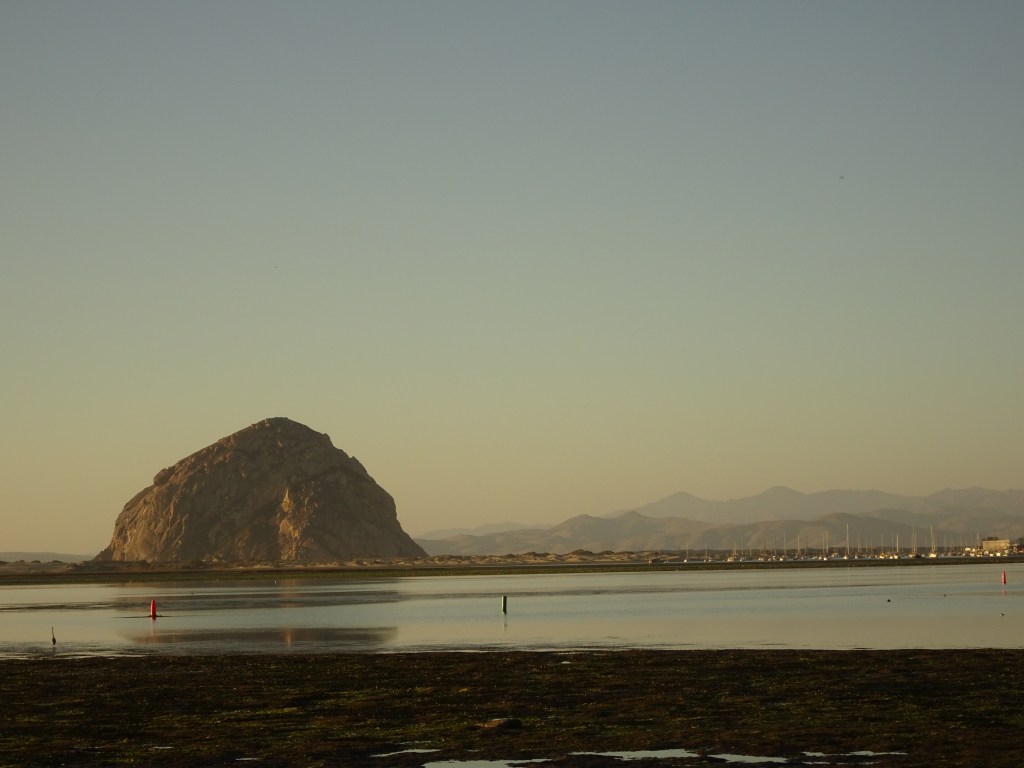
The next morning, we walked the boardwalk again along the estuary and saw a myriad of birds: flocks of cormorants, egrets, solitary herons and sandpipers and cruising above us falcons looking for easy prey. Even the odd monarch butterfly flitted by. We checked out the seaside village with all the galleries, tourist and surf shops, had the best roast beef sandwich at the Hofbrau waterfront café and watched the lazy sea-otters and sealions along the active harbour front. In the near distance loomed Morro Rock, a colossal plug left over from an ancient volcano and the defining landmark. We walked to the Inn on the Park which offered Happy Hour specials and spectacular views of the rock and sunsets on the bay. The weather was a balmy 20+ degrees. Life was good.
We needed our rear brakes fixed and were at the shop first thing on Monday morning. As promised, they got right to it and two hours and US$ 280 later, we had new rear brakes. We got another roast beef sandwich and parked by the beach next to the rock, watching the surfers and sea kayakers catching the waves.
Back at the campground we got our chairs and a drink and sat on the beach to watch the spectacular sunset show one more time. The next day we decided to start the long trek back up the coast heading for home. We stopped north of Hearst Castle (which we visited once before) to watch the young sea elephants resting on the same beach forever. We also stopped in Carmel by the Sea, a ritzy town full of high-end shops, expensive wine tasting rooms and classy villas lining the streets down to the expansive beach and adjacent park.
This time we opted to drive over the Golden Gate bridge and right through downtown San Francisco which proved easier than going around the city. We arrived at the Nelson winery, north of Hopland, our 3rd Harvest Host, just next to the #101. After some mandatory wine tasting we bought a bottle and camped under a massive oak tree next to the vineyard.
The next day we stopped for a seafood lunch at Crescent City and then made it to Gold Beach, Oregon where we stayed in the downtown RV park for the best deal yet. $ 40 for a full hook up and within walking distance to shops, restaurants and the beach. We meandered along the wild Oregon coast, marvelling at the dramatic scenery and made it to Gearhart just south of the Olympia Peninsula. One more pasta dinner in the van.
We were up early and made it to the border in good time and all the way to Horseshoe Bay where we got on the 4:20 ferry. We were happy to be home again after 5’000km and 3 weeks on the road.
The queen is dead. Long live the king. That about sums up this week in England. I happened to be in London at an Indian restaurant when the news of the Queen’s passing flashed on my phone. But life goes on. It’s been a trying week for the British. New prime minister, their Queen dying and a new King who has been waiting in the wings all his life. Flags are lowered in mourning, then raised in celebration during the proclamation, then lowered again. Churches and Cathedrals only open for mourners which is fine with me. I’m not a big fan of those massive monuments to celestial hubris, although their architecture and sheer size is impressive, considering they were built 800 to a thousand years ago with no machinery but thousands of labourers.
You would have thought that Charles would get some grief-time for his mom but no; there are procedures and protocols to be observed. The theater of royalty, preferably with as much pageantry and absurdity as possible. Brits like their history to come as costume drama.’ as John Crace from the Guardian dryly observed. Does anybody really want to see Charles’ face on a coin or a pound note or even on the Canadian currency? Hard to imagine.
The new king is more than just a pretty face. He actually made a landmark speech on saving the environment in 1970, just 21 years old, in Cardiff. He also founded Duchy Originals, a natural food company in 1990, at the time thought to be a folly but today it’s the most popular organic food brand in England. Together with the fortune of his estimated royal inheritance of over 20 billion, King Charles III is instantly one of the richest men on earth.
After a five-hour flight from Toronto we landed on the single air strip in São Miguel, at 750sqkm the largest of the cluster of nine volcanic islands that make up the Azores, a bucolic archipelago in the middle of the Atlantic, between Europe and North America, first colonised by Portugal in the 15th century.
The last localized active eruption was about 500 years ago but most of these islands were formed some 40’000 years ago, long before any seafarers or tourists had to worry about what’s under foot. Hot bubbling springs and steam vents are active today in several places all over this island and the distinct crater walls, wooded and green today, are tame but spectacular evidence of former geophysical violence. The porous volcanic rock and rich black soil provide the island with building materials and vegetation and the regular rainfalls supply plenty of water and keep the island green year-round.
We’re locked down in BC until the long weekend and although nothing much changes for us, it is stopping tourists and any non-essential travel to and from the Sunshine Coast. I wanted to check the numbers yesterday and just put in the date but the stats from a year ago came up. Wow. This year our infections are ten times higher but our hospitalizations and mortality percentages are lower. Still, a wakeup call.
I wanted to talk about something else with Camp besides the bloody covid for a change and came across an interesting piece of journalism the other day. Camp was already enjoying his pint, looking out at the rainy-day weather.
‘Camp, did you ever hear about Somaliland, the small African country the size of Greece that’s an independent and peaceful nation?
Banff was pleasantly accessible and didn’t feel crowded due to the lack of international tourists. A bonus for us visitors, a calamity for the local businesses. It will be a hard winter for many: from shop keepers to students, teachers to restaurateurs. We said farewell to our friends who both are connected to the Banff Centre, the artistic and intellectual heart of the mountain village, which in a normal year would bring in hundreds of artists and students from all over the globe but now sits mute and closed; its staff and students furloughed until past-Covid times it seems.
We left Cow Bay (the waterfront district in Prince Rupert named after Jean Nehring, a Swiss guy, who unloaded a herd of cows here in 1908) on a foggy morning and drove east along Highway 16 known as the Yellowhead Highway. Three main arteries connect this wet part of the world to the rest of Canada: The mighty Skeena River, the CNR rail line, originally called the Grand Trunk Pacific Railway, and the Yellowhead Highway often referred to as the Highway of Tears. The 750km stretch of road between Prince Rupert and Prince George has been the location of many murders and disappearances of First Nations women, beginning in 1970. All three arteries run parallel and we passed by 3 km long trains double-stacked with containers.
Road trips happen to be my favorite pastime. Driving along highways and byways, over passes, along rivers and lakes and through new towns is like a live movie with constant new scenes, impressions and input. Even driving through big cities can be exciting. It is certainly living in the moment. Lucky for me Clare is an excellent navigator and always checks her maps against the TomTom GPS which has been known to send people the wrong way.
The first thing that struck me about Lisbon is the immense width of the Rio Tejo (Tagus River), more like a lake, and how all the downtown buildings are attached to each other like four storied walls with windows. They are all built in a perfect grid, starting at the large Praca do Comercio, the main square at the vast river’s edge. There is no church or cathedral anywhere near the square but a heroic monument in the centre of the Marquis de Pombal, who rebuilt this city after the devastating earth quake of 1755. Pombal, a secular pragmatist, ousted the Jesuits but when Maria I came to the throne, she banned him from Lisbon’s soil, being heavily influenced by the Jesuits herself. Since the word terra means both ‘ground’ and ‘earth’, the story goes that the clever marquis packed a crate of soil from outside the city and put it down to step into it when he came back to Lisbon. (Voltaire Voltaire wrote Candide soon after the Lisbon earthquake and held up, as exhibit #1, the senseless death toll of the innocents in that catastrophe as conclusive proof of the absence of any Divine power, and certainly not any benevolent one.)
Unseasonal warm, August like temperatures, have banished old man winter for another year it seems. The skies are blue, the coastal mountains frosted with snow and Vancouver’s beaches are crowed with sun seekers.
‘Hey Camp, know what day it is today?’ I asked as soon as took my seat at our table with the view of the harbour.
I saw her the first time at Cuddy’s rum shop on the corner of Mainstreet. She wore a red and yellow plaid dress, a Redsox ball cap and large, golden hoop earrings. Her shoulder length hair was frizzy and stiff and twisted into dreadlocks. On her feet she wore plastic sandals that had seen better days. Her hands were like roots and her face was like Sonny Liston after his fight against Cassius Clay, with amber teeth and a flat nose. Her charcoal eyes looked into the distance and her head nodded to the incessant beat of the jab-jab trucks rolling slowly up and down Mainstreet, followed by gyrating partiers dressed in colourful carnival costumes.
We often can be found liming – that’s lounging in Caribbean speak – at Mama Joy’s beachside restaurant and bar on Paradise beach. Her establishment is a simple, open-air, planked platform with brightly coloured railings, covered by a corrugated tin roof. It features a wooden bar at one end, shuttered for the night, and a simple kitchen off to the side. It seats about 20 people on an odd collection of chairs and tables. The turquoise water laps the white beach just steps away where a couple of brightly coloured local boats are always bobbing on the gentle swell. It’s called Paradise Beach because that is what it is. We meet there to play cards, drink beer or rum punches and just hang out.
We spent some time on an island paradise where the most precious commodity is water and during the dry season – half the year – the most common fear is running out. The island has a desalination plant but when the government sponsored piping project failed within six months — because somebody tried to save some money by downsizing the pipe – the plant now sells and delivers water only by truck. The big houses have big cisterns, the small houses have small cisterns, mostly just black plastic tanks and they are the first to run dry. Of course the poorest people live in the smallest shacks and they don’t have money to buy water. Also the desalinated water still tastes salty and is no good to drink. And sometimes the water delivery guy is not available or off island or just doesn’t pick up the phone. People every year have to borrow and beg water from their neighbours or public places.
Havana is a ruinous city, like an old prostitute covered in too much makeup to hide the pain and suffering, but yet resilient and full of life. The crumbling facades of the wedding cake villas and opulent palaces of the former sugar barons and casino moguls, of the corrupt regimes before the revolution, bear witness to the ravages of time, decay and lack of money. Sixty years of neglect, coupled with numerous hurricanes and the salty fecundity of the climate is not a recipe for a well functioning infrastructure.
In October 2018, ten of us, cousins and spouses, ventured on a two-week trip to South Africa, organized by our youngest cousin, who grew up in South Africa. We took an overnight flight from Zurich, and arrived 9 hours later in Johannesburg where we were whisked off to the Johannesburg Country Club, a left over cluster of old manors and lounges from the Brits, sprawled over a few acres of groomed gardens and surrounded by a ten foot high wall, topped with electric security wires. Over a scrumptious, extended lunch we were treated to a bit of history from our cousin who loved this country of his birth with a natural passion and he also knew that we were curious and keen to know where we were.





 Bruno's point of view